
2025 NASA Space Apps Challenge
Table of Contents
A reflection on participating in the 2025 NASA Space Apps Challenge hackathon.
👉 한국어 버전
NASA Space Apps Challenge
NASA Space Apps Challenge is the world’s largest annual global hackathon. This two-day event aims to solve real-world problems facing Earth and space using NASA’s Open Data and space-based data from partner space agencies.
In the 2025 hackathon, a total of 114,094 people from 167 countries participated in 18,860 teams, and 11,511 projects were submitted.
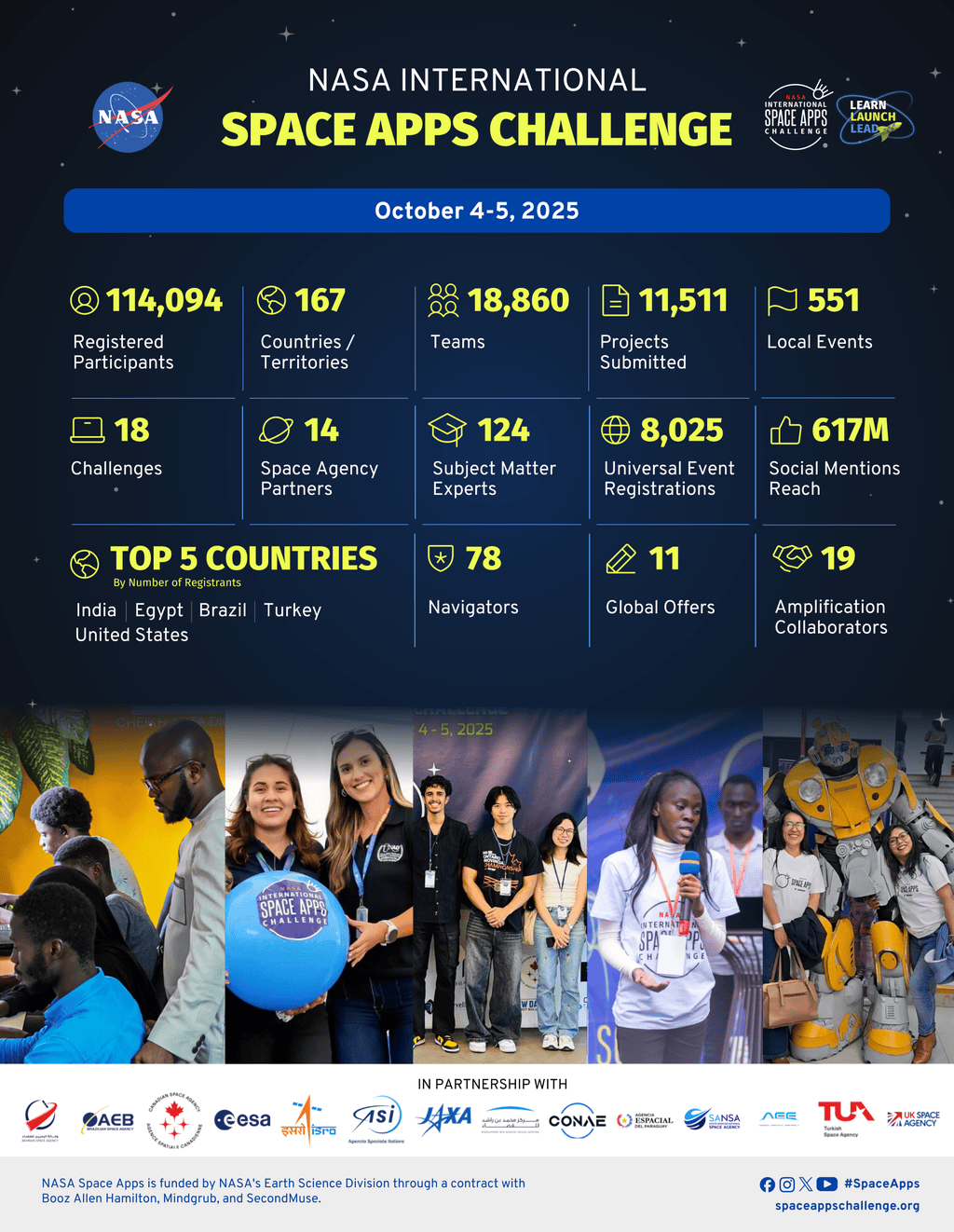 2025 NASA Space Apps Challenge by the numbers
The hackathon was held online over a weekend, and teams could consist of up to 6 members. A total of 18 challenges were released a month prior.
Participants can choose one of the challenges and conduct research and planning until the day of the hackathon.
Judging Criteria and Selection Process
The Global Winner selection process consisted of 3 stages. In Stage 1, 1,294 teams were selected as Global Nominees out of a total of 18,860 teams. Then, in Stage 2, 45 teams were selected as Global Finalists, and finally, in Stage 3, the top 10 teams were selected as Global Winners.
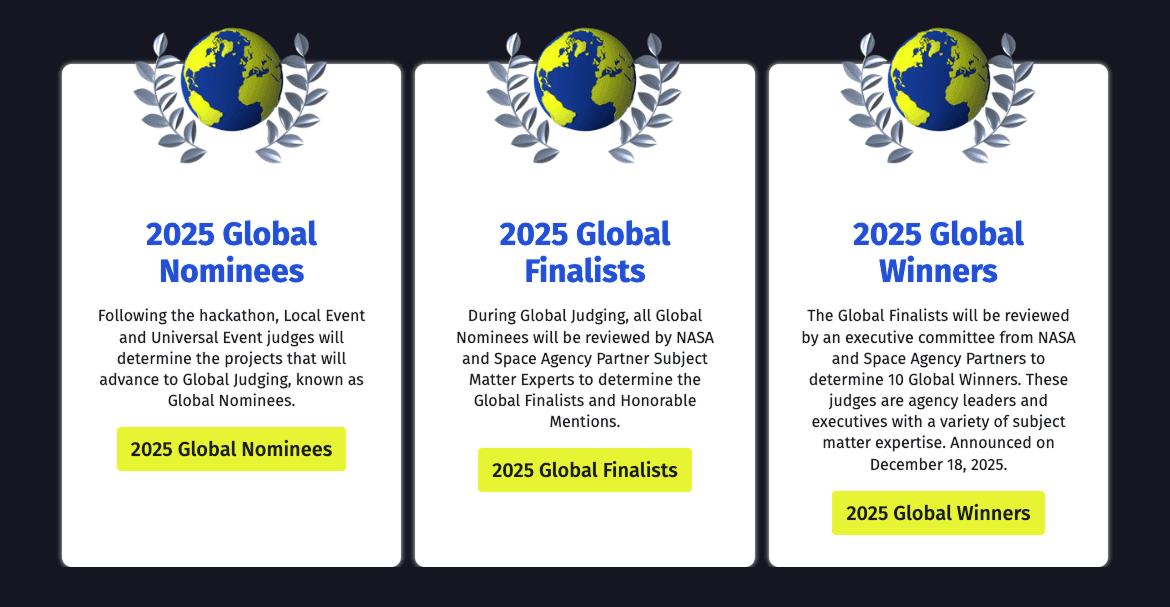 2025 Award
Stage 1: Local Event Judging and Global Nominees
Stage 1 Global Nominees are judged at Local Events. This hackathon featured Local Events in 167 countries, and detailed locations can be found at this link.
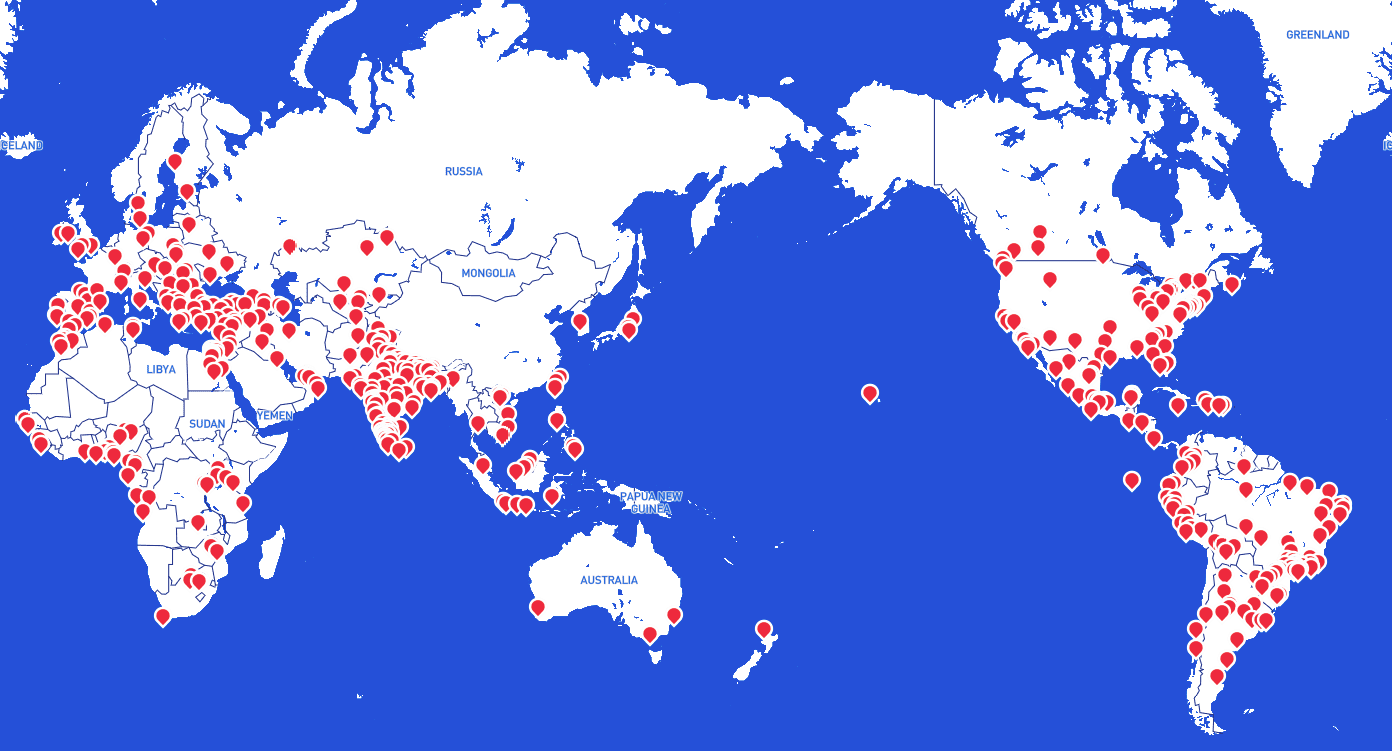 Local Events in 167 countries worldwide
In Seoul, Dr. Seong-Hong Park (Korea Astronomy and Space Science Institute, UST), Professor Hyun-woo Park (Seoul National University Graduate School of Data Science), Professor Soo-kyung Lee (Yonsei University Department of Computer Science), Professor Myung-hwan Yoon (Seoul National University Department of Industrial Engineering), and Lead Won-du Yu from AWS participated as judges.
A total of 54 teams applied for the Seoul regional event, and the following 4 teams were selected as Global Nominees:
1,294 teams out of 18,860 teams were selected as Global Nominees.
Stage 2: Global Finalists and Honorable Mentions
Global Finalists are determined by a vote of expert judges. In this hackathon, 45 teams were selected as Global Finalists out of 1,294 teams.
| Team Name | Local Event |
|---|---|
| Astro Sweepers | Universal Event |
| A.T.L.A.S. | Campinas, Brazil |
| Bagis | Manila, Philippines |
| BuBu | Taichung City, Taiwan |
| Celesta | Kanjirappally, India |
| Ceylon Xzora | Colombo, Sri Lanka |
| CloudMap | Universal Event |
| CosmicNova | Kuching, Malaysia |
| Earth Tellers 2 | Universal Event |
| ECI Centauri | Bogotá, Colombia |
| ExoVisionaries | Chattogram, Bangladesh |
| FyCUS | Seville, Spain |
| Gaia+LEO | Seattle, WA, United States |
| GRIT-X Awa | Universal Event |
| HammerSpaceCraft | Addis Ababa, Ethiopia |
| HerCode Space | Universal Event |
| HUEI-YING-OH | Kaohsiung City, Taiwan |
| iNFINITY MISSION | Sohag, Egypt |
| Luminexus | Valencia City, Philippines |
| Memora-Lab | Lima, Peru |
| Meteor Rizzlers | Kochi, India |
| naiπ | Recife, Brazil |
| NEIL A | Ahmedabad, India |
| NUPS | Seoul, South Korea |
| Pana2Orbit | Universal Event |
| Photonics Odyssey | Chennai, India |
| PureFlow | Aracaju, Brazil |
| QUEÑARIS | Arequipa, Peru |
| Resonant Exoplanets | Mountain View, CA, USA |
| ROBOKIDS-SPACE-A | Neiva, Colombia |
| So-Cal 2025 | Universal Event |
| SpaceGenes+ | Berlin, Germany |
| SPACEWALK | Seoul, South Korea |
| Stellar Minds | Universal Event |
| Stellar Narrators | Santo André, Brazil |
| Team Nomads | Cumilla, Bangladesh |
| TechNova | Ben Guerir, Morocco |
| TengriSpacers | Bishkek, Kyrgyzstan |
| The new Saraquatys | Campinas, Brazil |
| The Newtonians | Assiut, Egypt |
| ThinkSpace | Universal Event |
| Titan | Uberlândia, Brazil |
| Twisters | Monterrey, Mexico |
| Vitruvian 6 | Dhaka, Bangladesh |
| Zumorroda-X | Cairo, Egypt |
Although they didn’t advance to the next stage, 23 teams with outstanding creativity were mentioned as Honorable Mentions.
Stage 3: Global Winners
Global Winners are selected by NASA and the 2025 Space Agency Partner Executive Committee. A total of 10 teams were chosen, receiving the opportunity to have one-on-one virtual conversations with NASA scientists to celebrate their projects.
| Category | Winning Team |
|---|---|
| Best Use of Science | SpaceGenes+ |
| Best Use of Data | Resonant Exoplanets |
| Best Use of Technology | Twisters |
| Galactic Impact | Astro Sweepers |
| Best Mission Concept | PureFlow |
| Most Inspirational | Photonics Odyssey |
| Best Storytelling Award | HerCode Space |
| Global Connection Award | Gaia+LEO |
| Art & Technology Award | Zumorroda-X |
| Local Impact Award | QUEÑARIS |
The Three Solar Rascals
My team, SPACEWALK, chose the Stellar Stories: Space Weather Through the Eyes of Earthlings challenge. This challenge involves explaining what space weather is and its impact on various communities to children.
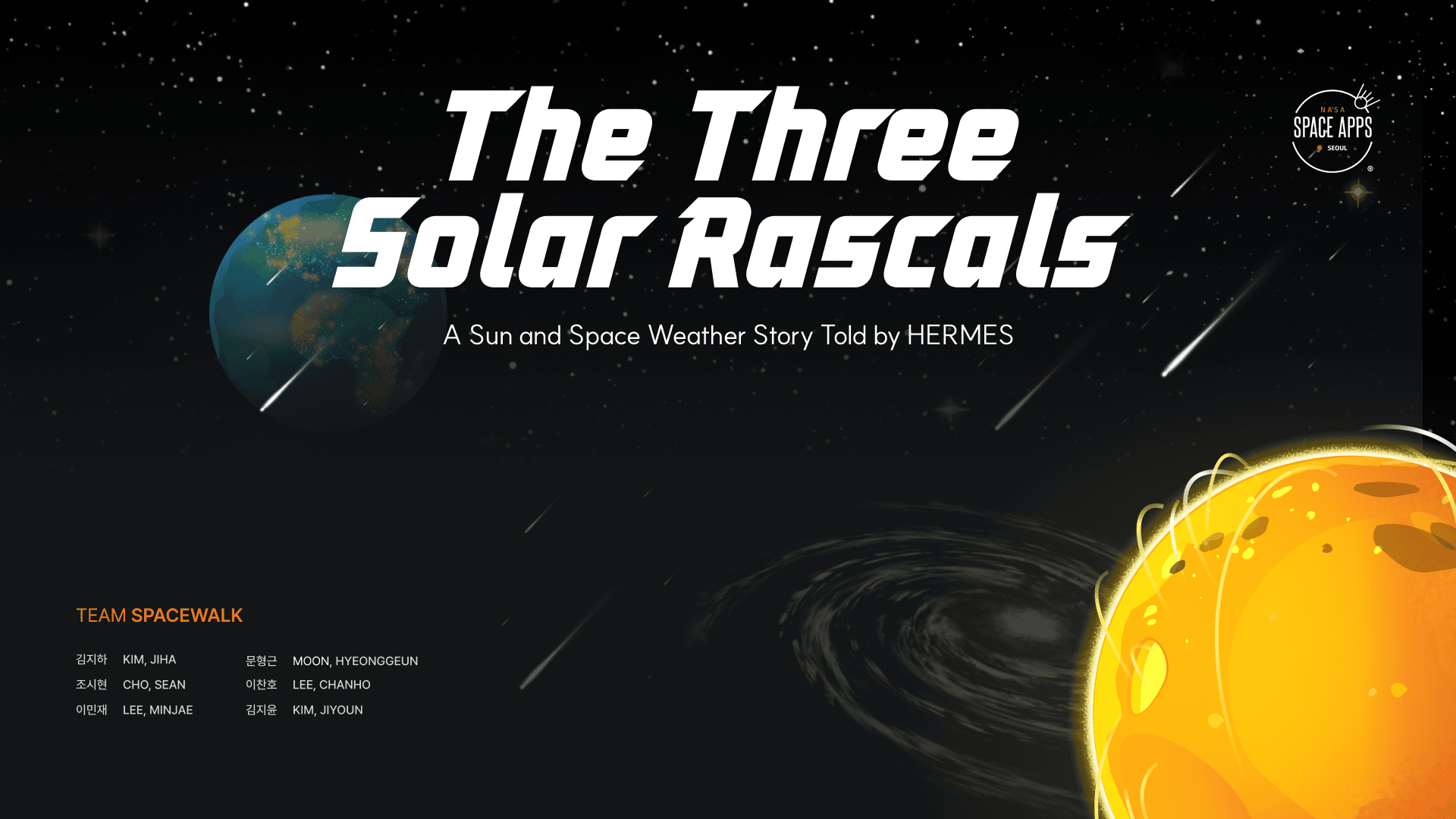 The Three Solar Rascals
As a result of the challenge, we created “The Three Solar Rascals,” an interactive iPad app that personifies Flares, Radiation Storms, and Coronal Mass Ejections (CME) from the sun to explain their impact on Earth. We even completed registration on the App Store within the hackathon period.
The Three Solar Rascals
👉 Github
👉 App Store
👉 Presentation
👉 SPACEWALK Team Profile
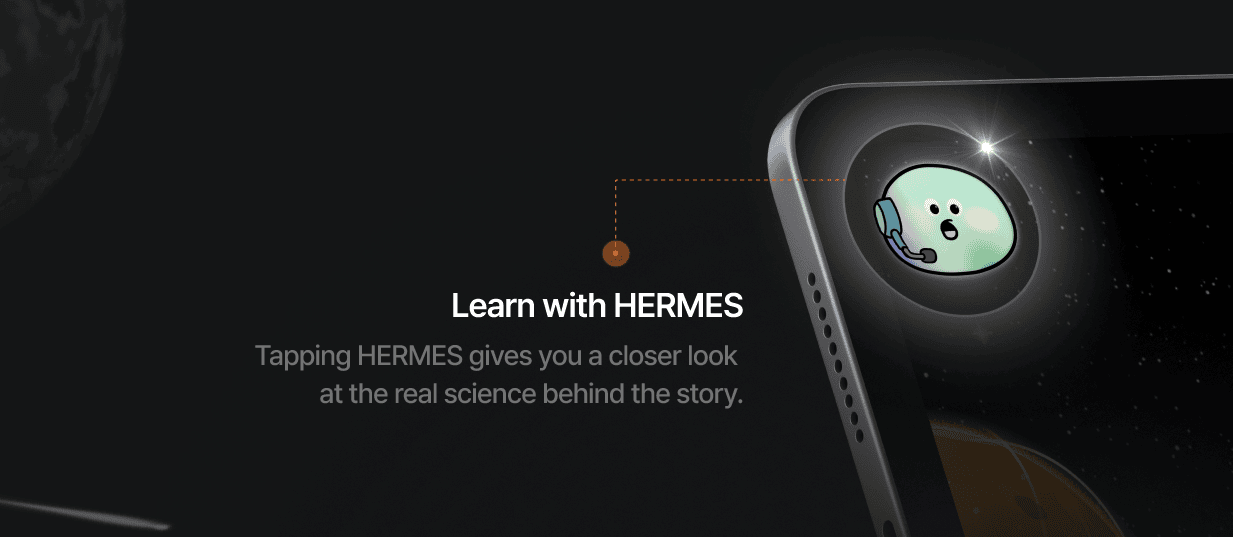
On the first screen, a cute HERMES character appears and starts the narration. This character personifies HERMES, NASA’s space weather observation instrument mounted on the Gateway, an international space station orbiting the moon.
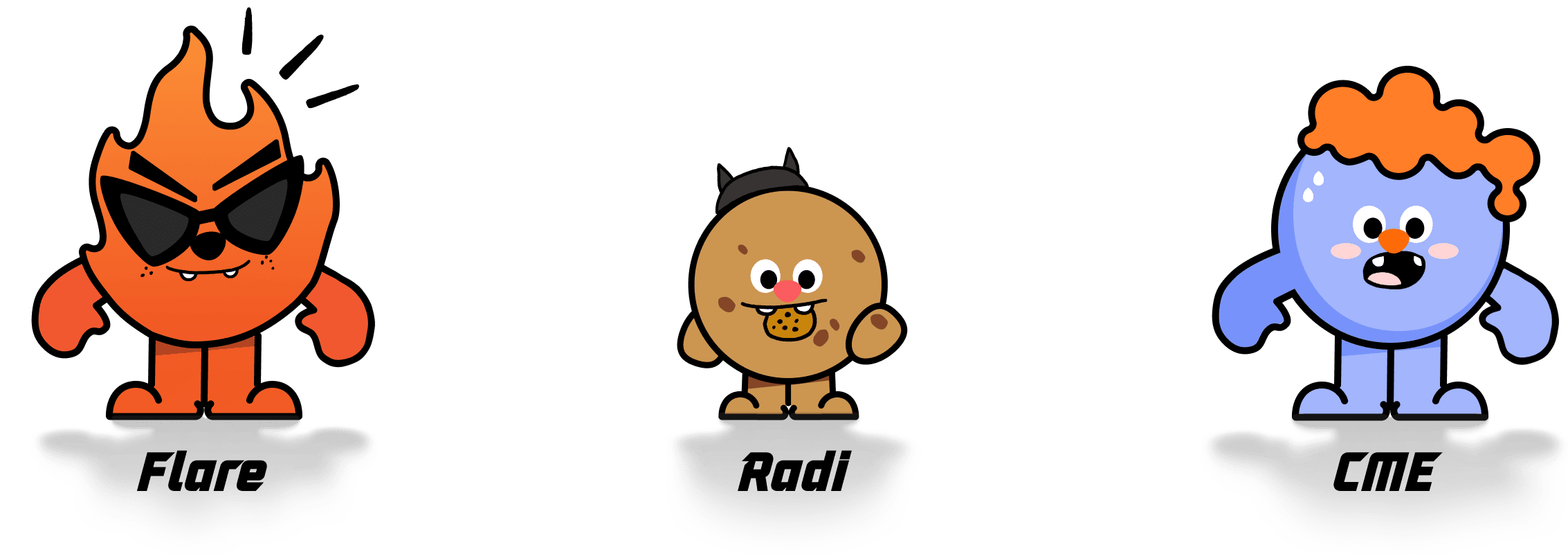
 Flare, Radi, & CME Characters
Solar storms are phenomena where particles, energy, magnetic fields, and matter are released into the solar system as the magnetic field gradually twists and becomes unstable due to differential rotation, where the sun’s equator rotates faster than its poles. Solar activity repeats a cycle of strengthening and weakening approximately every 11 years, and the number of sunspots (areas on the sun’s surface where the temperature is relatively low) increases as solar activity becomes more active.
In the app, we expressed these scientific facts by having the number of sunspots increase and solar activity become more active as time passes when the user swipes to rotate Earth around the sun.
The elements emitted from the sun are largely divided into three: Solar Flare, Radiation Storm, and Coronal Mass Ejection (CME). We created characters based on the characteristics of each element: Flare as a flame-shaped character, Radi as a cookie character that drops particles, and CME as a gassy character.
 Three friends flying from the Sun to Earth
| Category | Flare | Radi | CME |
|---|---|---|---|
| Official Name | Solar Flare | Radiation Storm | Coronal Mass Ejection |
| Main Composition | Electromagnetic Waves | Electrons & Protons | Plasma & Magnetic Field |
| Earth Arrival Time | Approx. 8 minutes | Under approx. 30 minutes | Approx. 15 hours ~ several days |
| Representative Impact | Radio Communication Interference | Satellite Circuit Damage | Potential Large-scale Blackouts |
We incorporated interactions to allow children to enjoy the story: the fastest character, Flare, slides when the iPad is tilted toward Earth; the particle-dropping cookie character, Radi, leaves cookie crumbs (particles) when the iPad is shaken; and the gassy CME character spins and flies away when the user blows on the iPad. We also structured the story so users can learn about the impact these characters have on Earth.
While the three friends might seem to have only negative impacts on Earth, the story concludes by showing that they form the Heliosphere in our galaxy, protecting planets from cosmic radiation and magnetic fields from outer space, and that the beautiful auroras are also created because of these friends. The aurora scene was implemented by cutting video frames so that each frame plays as the user drags the screen.
Demo
We implemented the app with various interactions so children can learn about the impact of space weather on Earth in a fun and engaging way.
The scientific facts used in the story were created with reference to materials provided by NASA.
- HERMES - NASA Science
- Solar Storms and Flares - NASA Science
- Sunspots - NASA Science
- Heliosphere - NASA Science
- Results of the First National Survey of User Needs for Space Weather (NASA resource)
- Space Weather - NASA Science
- NASA | X-Class: A Guide to Solar Flares
- How Does the Sun’s Magnetosphere Cause Aurora by Rachel Geiter - NASA Science
- NASA, NOAA: Sun Reaches Maximum Phase in 11-Year Solar Cycle
- Solar Cycle Progression and Forecast - NASA Science
- Solar Cycle Progression - NOAA Scales
- Aurora Tutorial - NOAA Scales
Since the active use of AI was encouraged in this hackathon, we used generative AI for TTS (Text To Speech) voices and image asset production.
Conclusion
 SPACEWALK Team
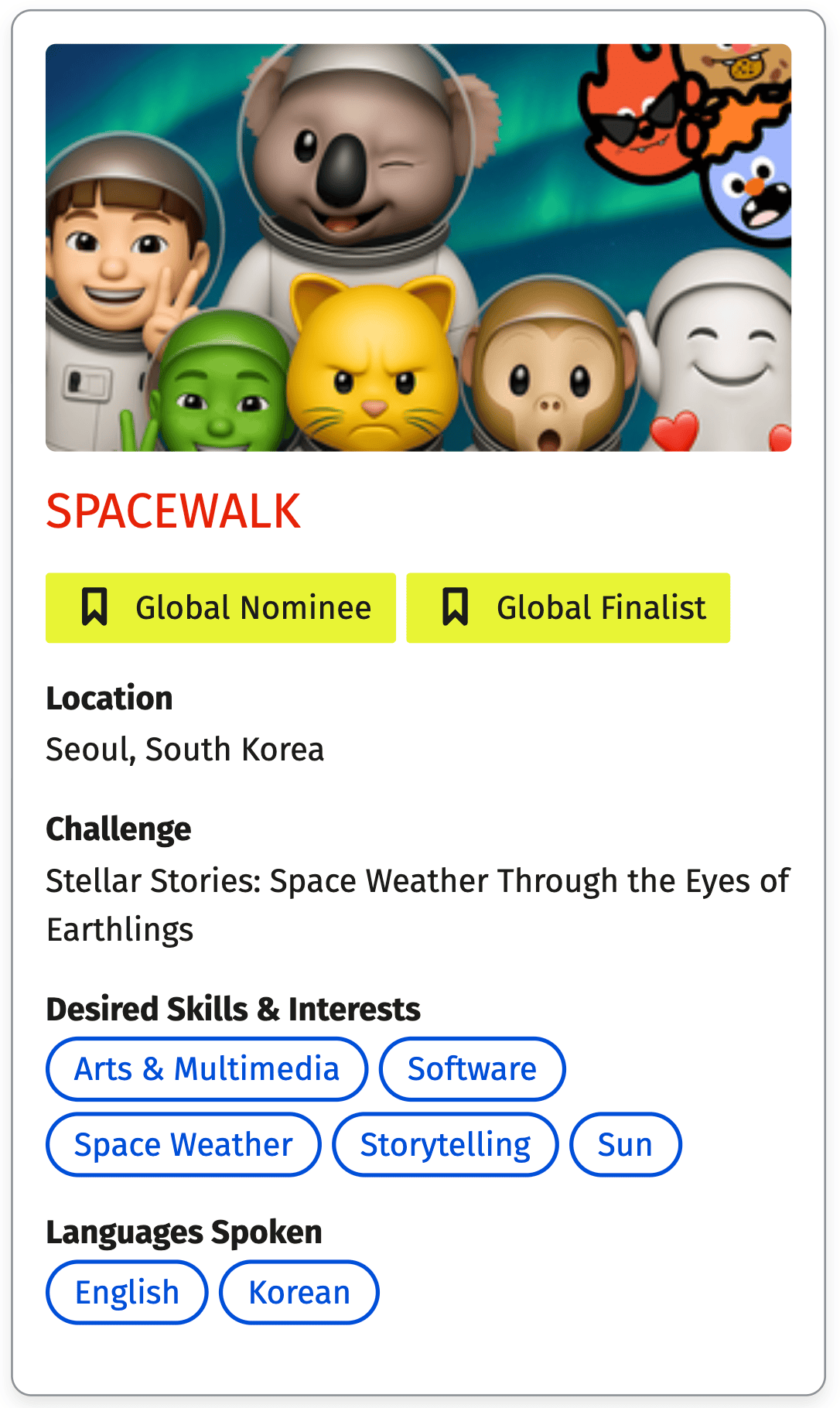
The SPACEWALK team was named a Global Finalist, being selected as one of the top 45 teams out of 18,860. Although we didn’t go on to become a Global Winner, it was a truly meaningful time to challenge ourselves alongside fellow runners from the 4th Apple Developer Academy and build valuable experiences and precious memories.
The Three Solar Rascals
👉 Github
👉 App Store
👉 Presentation
👉 SPACEWALK Team Profile